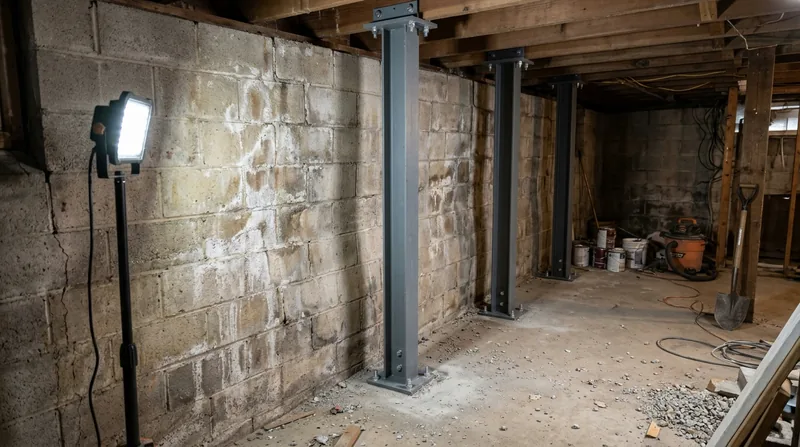




Topeka sits on ground that moves. The Kansas shale and clay-rich residual soil under most of this city swells hard after a wet spring and shrinks again in a dry August, and that cycle pushes against basement walls year after year. In older neighborhoods like Oakland, Potwin and North Topeka, many 1900s-1930s brick and frame houses still have full basements built of stone or early block, and those walls were never designed for the pressure a modern water table puts on them. If you have noticed a wall leaning inward, a horizontal crack widening, or a floor that no longer meets the wall squarely, you are looking at a Bowing Wall Repair in Topeka problem, and it gets worse, not better, with time. We stabilize leaning and bowing foundation walls with carbon fiber straps, steel I-beams, or wall anchors, matched to how far the wall has moved and what your soil is doing. Start with a free basement inspection so we can measure the movement before anything is ordered.
Why Bowing Walls Are Common in Topeka's Clay and River-Bottom Basements
The dominant failure mode here is hydrostatic pressure from swelling clay, not impact damage and not frost heave. When heavy May and June thunderstorms soak the hillsides above downtown, the water table rises and saturated clay presses laterally on basement walls. Older block and stone walls in Hi-Crest and the east side, many cut into the slope, take that load on a wall that was laid with lime mortar and no reinforcement. Poured walls in the newer west and south subdivisions crack and bow too, just more slowly.
- Walls bow inward most often after a wet spring, when clay is fully saturated and pushing at maximum load.
- Horizontal cracks in the middle third of a block wall signal lateral pressure, not settling.
- Stair-step cracking at the corners of older stone basements usually means the wall is rotating at the top.
- White efflorescence and a musty smell tell you water is already moving through the wall.
- A floor slab that has heaved or separated from the wall means the movement is active, not historic.
If any two of those signs are present, the wall needs to be measured and monitored, not painted over.
Key info: A block wall in Potwin that bows a quarter inch over one wet season can move a full inch over the next three. The 1951 Kansas River flood is still in local memory, and the river-bottom lots near the Kansas River are the first to show pressure when the water table climbs.
Structural repair of this kind is permitted work in most Kansas jurisdictions, and the rules vary by city and county. Verify requirements with the local building department before work begins. The Kansas Attorney General's consumer protection pages are a useful starting point for checking a contractor's registration: Kansas Attorney General Consumer Protection.
How We Diagnose and Stabilize a Bowing Wall in Topeka
We do not sell a strap to every wall. The first job is to find out whether the wall is still moving, how much it has deflected, and what is driving it. That means a plumb-line or laser measurement along the wall, a look at the soil and grading outside, and a check of the drain tile and footing drain. If the cause is water, stabilizing the wall without fixing the water is wasted money.
- We measure the wall's deflection at several points and record it, so we have a baseline to compare against.
- We inspect the exterior grade, downspout extensions, and window wells to see where water is entering the soil.
- We check the interior perimeter drain and sump basin to confirm whether the footing drain is still moving water.
- We recommend the lightest method that will hold the wall: carbon fiber straps for minor bowing, steel I-beams for serious deflection, wall anchors where the soil outside allows.
- We address the water source with interior drain tile or exterior membrane work so the repaired wall is not reloaded.
The order matters: stabilize, then dewater, then monitor. Skipping the dewatering step is the most common reason a repair fails.
Key info: On a 1950s brick ranch in Hi-Crest, we found a block wall bowed 1.5 inches with a horizontal crack at mid-height. Carbon fiber straps on the interior face plus a new interior perimeter drain brought the wall back to stable within one season, and the homeowner could finish the basement without fear of the wall moving again.
Bowing Wall Repair Methods We Use in Topeka
Each method fits a different severity and a different soil condition. We match the approach to the wall, not the other way around.
| Approach | Description | Best for |
|---|---|---|
| Carbon fiber straps | High-strength straps epoxied to the interior wall face and anchored top and bottom. | Minor to moderate bowing, up to about 2 inches of deflection. |
| Steel I-beams | Vertical steel beams set against the wall and tied into the floor and joists. | Serious deflection, block walls, and walls that must be straightened over time. |
| Wall anchors | Steel plates on the interior wall connected to anchors buried in stable soil outside. | Bowing walls where exterior access is available and soil is stable enough to hold. |
| Epoxy or polyurethane injection | Resin injected through ports to seal cracks and fill voids behind the wall. | Crack sealing and void filling, not structural straightening on its own. |
If the wall is bowing because water is still loading it, the structural method alone will not hold. We pair the repair with drainage work, and we tell you plainly when simple crack sealing is enough and when the real problem is pressure.
Bowing Wall Repair Cost in Topeka: What to Expect
Homeowners ask for a number before they ask for anything else, and that is fair. Bowing wall repair in Topeka starts from $600 for a limited crack and void injection, and climbs from there based on how much wall is moving and which method fits. Carbon fiber straps on a single wall typically run in the low thousands; steel I-beams and wall anchors cost more because of the steel, the excavation, and the engineering. A full-wall stabilization on a river-bottom stone basement is an on-site estimate every time.
- The length of wall that has moved is the biggest cost driver, since straps and beams are priced per foot.
- Whether the wall can be stabilized from the inside or needs exterior excavation changes labor substantially.
- Drainage work (interior drain tile, sump pump, discharge line) is priced separately and is often necessary.
- Access matters: a basement under a 1920s North Topeka house with a narrow stair and low headroom takes longer than a walkout in a west-side subdivision.
- Engineering or permit fees, where the local building department requires them, are part of the honest number.
Get two or three estimates and compare what is actually included, not just the bottom line. Our full pricing overview lays out the ranges so you can read each bid against a real baseline.
Finding a Bowing Wall Repair Contractor Near Me in Topeka
This is a specialty trade, and not every foundation firm does it well. A general foundation-repair company may pour piers for settling and still not know how to stabilize a bowing block wall. A plumber can fix your sump discharge and still not read a horizontal crack. Ask direct questions and expect direct answers.
- Confirm the contractor is licensed and insured, and ask for a certificate of insurance before work starts.
- Get at least two or three written estimates that specify the method, the linear footage, and whether drainage is included.
- Ask for references from jobs in Topeka or nearby towns like Silver Lake, Tecumseh, or Auburn, and call them.
- Ask who pulls the permit, because structural foundation repair commonly requires one and thresholds vary by jurisdiction.
- Check whether your neighborhood or HOA has rules about exterior excavation or anchor placement before the crew arrives.
If a contractor will not put the method and the footage in writing, keep looking. Reach us through the contact page and we will walk your basement and give you a straight answer, including when the cheaper option is the right one.
Bowing Wall Repair Near Me: What Topeka Homeowners Should Know
Most bowing walls in this city announce themselves slowly. You see a crack you did not notice last year, or a door at the top of the basement stairs stops latching. In Topeka's climate, the wet spring is when walls move fastest, and the dry summer is when the cracks look worst because the clay has shrunk away. A wall that is stable in August can be under real load again by May.
Do not wait for a wall to displace several inches before calling. The earlier the measurement, the more options you have, and the more likely a lighter method like carbon fiber will do the job. If you are in Lawrence, Perry, or Lecompton, the same clay and the same river-bottom conditions apply, and we cover those areas too.
One more thing: a bowing wall is a structural issue, not a cosmetic one. Patching the crack from the inside with hydraulic cement hides the symptom and leaves the cause in place. We would rather tell you that on the phone than take your money for a patch that will fail.
Bowing Wall Repair in Topeka: Pricing Guide
| Service | Price | Details |
|---|---|---|
| Crack and void injection | Starting at $600 | Epoxy or polyurethane injection of a limited crack, priced per port and linear footage. |
| Carbon fiber strap stabilization | Starting at $1,800 | Interior straps on a single bowed wall, priced per foot; wall length and deflection drive cost. |
| Steel I-beam or wall anchor system | On estimate | Serious deflection or exterior excavation requires an on-site measurement and engineering review first. |
| Drainage correction add-on | Quoted separately | Interior drain tile, sump pump, and discharge work priced apart from the structural repair. |
| Travel | Included | In Topeka and surrounding areas, no separate call-out or mileage fee. |
| Estimate | Free | Response within 24h at (785) 783-0183, no obligation to book. |
Indicative pricing, the exact cost depends on square footage, finish, and site access. Free personalized estimate within 24h at (785) 783-0183.


